Certificate Lifecycle Management
Every SSL/TLS certificate is a machine identity. Find, issue and renew yours in one place, and deploy them where they run, without an agent.












Trusted by Security Teams Worldwide


See every certificate in one inventory
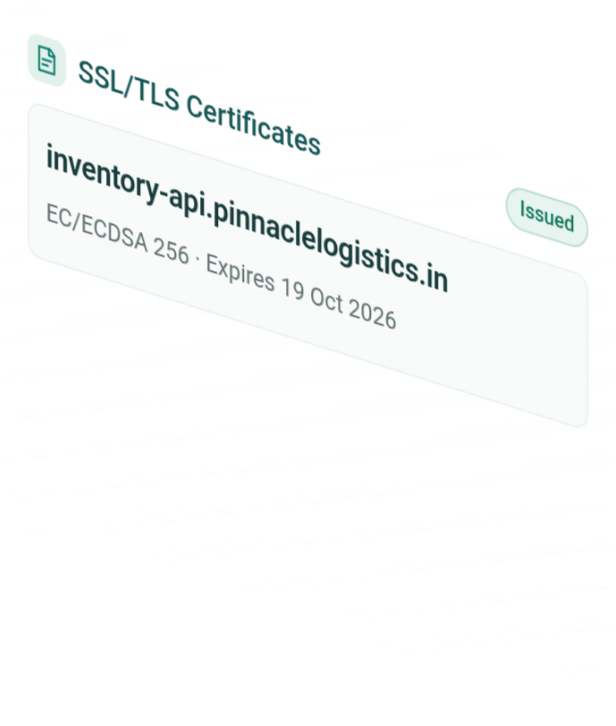
Certificates are issued by different teams, through different authorities, onto different servers. Securden brings the ones discovered on connected systems, issued in the platform or added by hand into one list, so you can see what you have and when it expires.

Certificate details
See the issuer, common name, key algorithm and key size.
Self-signed report
List the certificates that no trusted authority has signed.
Download and clean up
Download certificates when you need them, and remove the ones you no longer use in bulk.
Issue certificates through your existing authorities
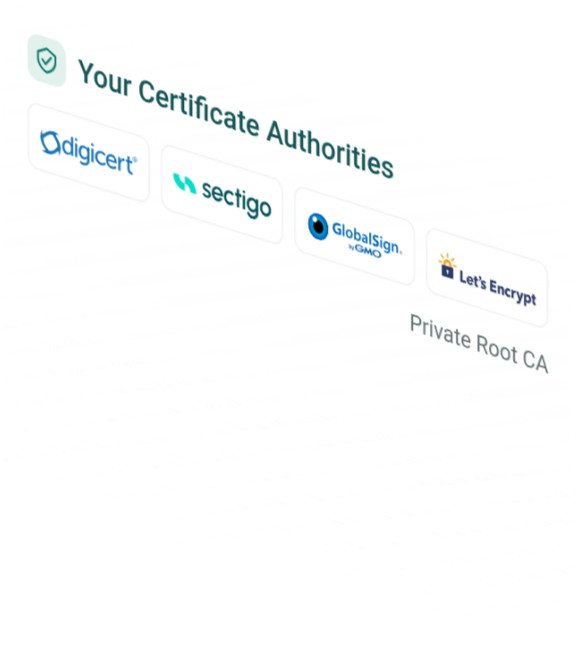
Create certificate signing requests (CSRs) in the platform and choose who signs them: a public certificate authority (CA), an ACME provider or your own private CA. Save the details you reuse as templates, and set the key type, key size and validity period for each request.
Public CAs
Request certificates from GoDaddy, The SSL Store, DigiCert, GlobalSign, Sectigo, Entrust and emSign.
ACME providers
Get certificates issued automatically by Let's Encrypt, Buypass Go SSL, ZeroSSL or Telia, or add any other ACME-compatible provider.
Private root CA
Create your own CA for internal servers and applications.
Self-signed
Sign certificates yourself for internal or test systems.
Renew certificates before they expire
Public TLS certificates now last at most 200 days, dropping to 100 days in March 2027 and 47 days in March 2029. Each cut adds renewals, and each renewal is another date your team can miss.
Expiry dashboard
See expired certificates and those expiring within seven days.
Faster renewals
A fresh CSR goes to the issuing CA in the background.
ACME auto-renewal
Certificates from ACME providers renew without manual steps.
Revocation
Revoke a certificate when its private key is exposed or the system it protects is retired.
Expiry reports
Report on certificates expiring in any period you choose and on those already expired, in PDF, CSV or XLSX.
Deploy certificates where they run, without an agent
A renewed certificate protects nothing until it is installed on the machine that uses it. Push certificates from the platform to Windows and Linux machines, including the Microsoft Certificate Store.
 Windows
- No agent: Deployment connects through OpenSSH on the target machine.
- One place: Issue, renew and deploy without moving files between tools.
Works with the authorities you already trust
Connect public CAs, ACME providers and your own private root CA, and deploy to Windows and Linux.













Manage certificates with the rest of your machine identities
Track, renew and deploy SSL/TLS certificates from the same platform as your service accounts, API keys and secrets.